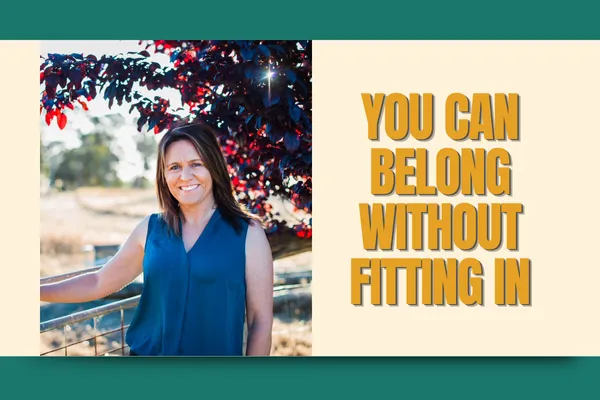
You Can Belong Without Fitting In
There is a subtle difference between fitting in and belonging.
Fitting in asks you to notice the rules of the room and work out how closely you can follow them. Belonging is different. It suggests that you can enter the room as yourself — with your quirks, contradictions, opinions and differences intact — and still have a place there.
That distinction becomes particularly important in midlife, when many of the identities and communities we once inhabited without thinking begin to shift. The school-gate friendships change. The children's sport disappears. A career ends or changes shape. Friendships evolve. Relationships are renegotiated. Sometimes we discover that the group we once fitted neatly into no longer feels like home.
The conventional advice is usually to "find your tribe".
But perhaps belonging is more complicated than that.
The problem with finding your tribe

Community wellbeing strategist Renee Knapp has spent much of her working life thinking about what makes people feel connected. Her own experience has also taught her that belonging isn't a permanent status you achieve and then keep.
At one point, after leaving a 28-year career in education, changes in her children's lives and shifts in the family farm, several of the places where she had naturally connected with other people disappeared at once.
Later, she realised she hadn't simply been grieving change.
She had been grieving belonging.
That experience sits alongside another of Renee's strongest ideas: belonging doesn't look the same for everybody.
There isn't a single formula.
For some people, a sporting club is the centre of their social world. For someone else, the thought of joining a team might sound exhausting. Some people thrive in large groups. Others need one or two close relationships and plenty of time alone. One person's community can be another person's sensory nightmare.
Even within a relationship, people can experience connection differently. Renee describes herself as highly social while her husband is much less interested in constant interaction. Difference doesn't necessarily have to be solved.
It can simply be understood.
That sounds obvious until we look at how often communities are designed around an assumed "typical" person.
What if we stopped deciding what people need?

One of the most useful examples Renee shares comes from her community work with older people.
Organisers wanted to encourage greater participation and could easily have designed a list of activities they thought would bring people together.
Instead, they asked what would actually make it easier for people to attend.
The answers weren't complicated. People wanted access to toilets, water and somewhere to sit.
The lesson is bigger than event planning.
We are often very enthusiastic about creating things for people without asking them what they actually want, need or find difficult.
That applies to workplaces, families, friendship groups, community organisations and even our closest relationships.
We assume we know.
Then we become frustrated when our perfectly sensible solution doesn't solve the problem.
Renee's alternative is curiosity.
Ask first.
Listen properly.
Then build.
It is a deceptively simple approach, but it changes the relationship between the person designing the community and the person supposedly being included in it.
You don't create belonging for someone.
You create the conditions in which they can help create it with you.
Belonging doesn't require agreement

This is where the idea becomes more interesting.
Renee's view is that true belonging means feeling part of something while still being accepted for who you are.
That doesn't mean every group needs to become an endless exercise in consensus.
Quite the opposite.
Perhaps healthy belonging has to make room for disagreement.
Gry's lens on the conversation pushes this further: real belonging should not require us to shrink, perform or become more like everybody else. The question isn't simply whether we have found people who agree with us. It's whether we can be different from them without losing our place.
That is a much more useful test.
Think about a friendship where you can disagree without wondering whether the relationship is suddenly at risk.
Or a family where everyone knows they are allowed to have a different view.
Or a workplace where challenging an idea doesn't mean challenging someone's right to be there.
Or a community where participation isn't conditional on looking, thinking or behaving exactly like the people who established it.
Sameness makes groups easier to organise.
Difference makes them harder.
But difference is not the enemy of belonging.
It may be the test of it.
Sometimes the behaviour is telling you something

Renee's story about a young person who was spending large amounts of time gaming online is another example of why curiosity matters.
The obvious problem appeared to be gaming.
Look underneath it, and something else emerged: at school, he struggled to find people he connected with. Online, he had found acceptance.
That doesn't mean every concern about gaming should be dismissed. Nor does it mean online communities are automatically healthy.
It means behaviour can sometimes be an imperfect solution to a very human need.
Instead of asking only, "How do we stop this behaviour?", it can be worth asking, "What is this giving the person that they aren't getting somewhere else?"
That question can change the conversation.
It moves us away from judgement and towards understanding.
And sometimes understanding reveals a much more practical problem to solve.
Belonging as part of the mental-health picture
Renee's work also challenges the idea that mental wellbeing exists primarily inside the healthcare system.
Professional support matters enormously, particularly when someone is experiencing significant mental-health difficulties. But people don't live inside healthcare systems.
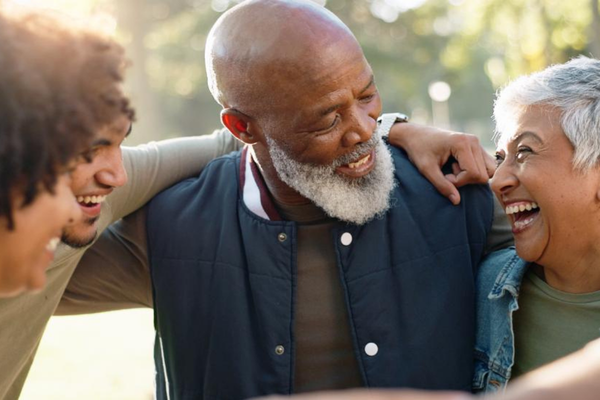
They live in families, schools, workplaces, sporting clubs, neighbourhoods and communities.
They need somewhere to belong.
They need purpose.
They need people who notice when they aren't themselves.
They need opportunities to contribute and be useful.
Community is not a substitute for appropriate healthcare. But neither should healthcare be expected to carry the entire burden of human wellbeing.
That distinction feels particularly important in a culture that can sometimes turn every human difficulty into an individual problem to be treated.
Sometimes the question isn't only, "What's wrong with this person?"
It might also be:
"What is missing around them?"
A different question for the messy middle
The older we get, the more likely it is that belonging needs to be rebuilt rather than inherited.
When children leave, careers change, relationships shift or familiar communities disappear, the answer isn't necessarily to find a replacement version of what you had.
It might be to ask what belonging means to you now.
Where can you disagree and still feel safe?
Where can you be useful without having to prove your worth?
Where can you be slightly odd?
Where are you accepted rather than merely tolerated?
And, perhaps most importantly, where are you helping to create the kind of community you wish existed?
Because belonging isn't only something we go looking for.
Sometimes we have to build it.
And perhaps the most interesting communities are not the ones where everybody fits in.
They are the ones where nobody has to.
Podcast invitation
Renee Knapp's Vitalify Unplugged conversation explores these ideas through her own experience of losing and rebuilding sources of belonging, her community wellbeing work, the unexpected lessons of online gaming, and her belief that communities need to listen before they assume. The episode also asks a harder question: can we remain connected when we don't agree?
