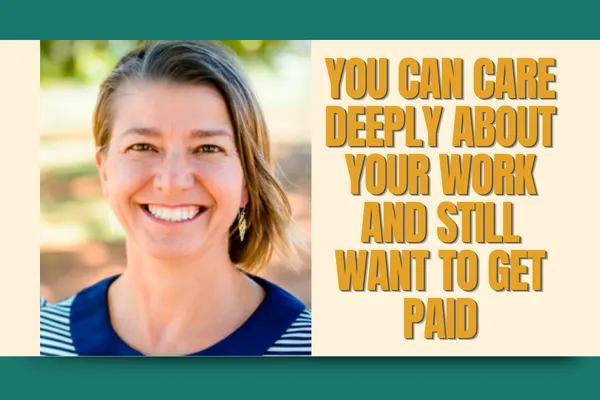
You Can Care Deeply About Your Work and Still Want to Get Paid
There is a peculiar bargain hidden inside the idea of purpose.
Find work that matters. Make a difference. Help people. Serve a cause. Follow your passion.
Just don't make the money part too obvious.
We rarely say this out loud, but there can be an unspoken expectation that meaningful work should somehow operate outside ordinary economics. If you care enough, you'll keep going. If the cause is important enough, you'll find a way. If you're genuinely committed, perhaps you shouldn't be thinking too much about income at all.
Except rent exists.
Families need feeding. Mortgages need paying. Bodies need looking after. And, inconveniently, people doing meaningful work need to live too.
Belinda Smith knows this tension from the inside.
Her career in children's health advocacy grew out of an intensely personal experience involving her family's health. What began as a desire to help other families eventually became more than a decade of advocacy, education and public speaking. But pursuing that mission came at a considerable financial and personal cost. Belinda and her family sold their Sydney home to fund a converted bus and travel around Australia raising awareness. Later, significant funding disappeared, her business income collapsed and she took on part-time work to keep going.
There was shame attached to that, too.
And that's where her story becomes much more interesting than another tale about burnout.
When purpose becomes a test of how much you can sacrifice

Belinda is unusually candid about the fact that she isn't a perfect example of balancing impact, health and financial needs. When Stephanie asks when service becomes self-sacrifice, Belinda acknowledges that she has struggled with exactly that line. She describes working late, neglecting her own needs and becoming more committed to other people's health than her own.
It's easy to admire this kind of dedication from the outside.
It's much harder to live with it.
Women are particularly familiar with the logic. If you are good at something, you become the person everyone asks. If you care, you say yes. If you can help, you do. Eventually the thing that began as generosity becomes an expectation — and sometimes an identity.
The trouble is that purpose can become a remarkably effective disguise for overwork.
You can call it commitment.
You can call it service.
You can call it passion.
Your nervous system may have a different opinion.
The more uncomfortable question is whether we've confused being needed with being effective.
Those aren't the same thing.
Your mission can stay while the model changes

Belinda's next chapter is what makes this story hopeful without turning it into a neat inspirational lesson.
She isn't abandoning the work.
She's changing how she does it.
After years of grassroots programmes, she's looking towards broader work as a food literacy strategist, speaking and influencing education leaders and decision-makers who can affect systems rather than trying to personally deliver every piece of change herself. At the same time, she is imagining a life that includes travel, financial sustainability and time to actually enjoy it.
That distinction matters.
Sometimes we think the choice is between staying true to our purpose and giving it up.
But there may be another option: keep the mission, change the model.
That could mean charging differently.
It could mean moving from delivery into strategy.
It could mean teaching instead of doing everything yourself.
It could mean speaking, writing, consulting, building intellectual property or reaching decision-makers rather than trying to personally solve every problem.
It could even mean deciding that your next chapter needs to contain more pleasure.
None of those things necessarily makes the work less meaningful.
They may make it more sustainable.
Passion, purpose and prosperity

This is where Steph's reflection on the conversation becomes particularly useful: passion, purpose and prosperity woven together.
There is something refreshingly unromantic about putting those three words beside one another.
Passion sounds noble.
Purpose sounds noble.
Prosperity sounds suspiciously commercial.
But why?
If your work genuinely creates value, why should being paid for that value make the work less virtuous?
Gry pushes the question further. She sees the problem not as a lack of purpose, but as a tendency to assume that meaningful work should resemble charity. Her challenge to Belinda is essentially that she doesn't need to become a thought leader; she already is one. Perhaps the next step is recognising the value she has built and positioning it accordingly.
That is a very different proposition from “work harder”.
It is value differently.
You are allowed to want a life as well

Perhaps the most revealing detail in Belinda's future vision is not the strategic shift.
It's Tuscany.
She wants to be able to contribute, earn and experience the world at the same time — ideally from somewhere with a balcony and a view.
It's a wonderfully ordinary ambition.
And maybe that's exactly why it matters.
We can become so accustomed to measuring meaningful lives through contribution that enjoyment starts to look like an indulgence. We celebrate the woman who gives everything to the cause, the family, the organisation, the community. We don't always ask whether she likes the life she's built.
Belinda's menopause transition appears to have prompted some of those questions for her. With her children getting older and one recently leaving home, she began thinking differently about what she wanted the next chapter to look like.
That is a very midlife question.
Not simply:
What am I here to do?
But:
How do I want to live while I'm doing it?
Those questions belong together.
Purpose should leave something for the person doing it

Belinda has started one simple practice that makes this tension visible.
Each evening, she writes down what she has done that day to care for herself.
Some days there is meditation, walking, Tai Chi or time at the beach. Other days, the list is almost empty.
The point isn't perfection.
It's noticing.
And perhaps that is the bigger lesson here.
Purpose shouldn't require you to disappear.
You don't have to choose between making a difference and making a living. You don't have to prove that your work matters by demonstrating how much you're willing to sacrifice for it.
The better question may be whether the way you're currently doing meaningful work allows you to remain a person inside it.
A person who gets paid.
A person who rests.
A person who travels.
A person who has relationships and interests and an afternoon off.
A person who occasionally sits on a balcony in Tuscany and enjoys the view.
Because if the purpose is to make the world better, surely the person doing the work is allowed to have a life in that world too.
A question worth asking
What would change if you stopped measuring your commitment by how much you sacrifice?
And then, perhaps more practically:
What would make the work you care about financially and personally sustainable?
That may not require abandoning your purpose.
It may require valuing it differently.
Podcast invitation
In the full Vitalify Unplugged conversation, Belinda talks candidly about the financial and personal cost of building purpose-driven work, losing funding, menopause as a turning point, and the shift she is making towards a model that can hold impact, income and a life of her own.
