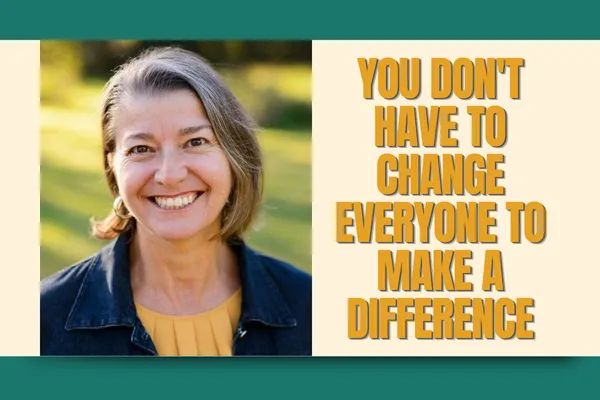
You Don't Have to Change Everyone to Make a Difference
There is a particular kind of exhaustion that comes from caring about something other people don't seem to care about.
You explain.
You share information.
You try a different argument.
You send the article.
You have the conversation again.
And still, nothing seems to change.
For women who care deeply about their families, communities, work or causes, this can become a familiar trap. We start believing that if something matters enough, we are responsible for persuading everyone else to see it too.
Belinda Smith's experience suggests a different way of thinking about influence.
You don't have to change everyone.
In fact, trying to do so may be one of the least effective ways to spend your energy.
Curiosity travels further than criticism

Belinda's work in children's health began with what happened inside her own family. After her husband's postnatal depression, the family began paying closer attention to sleep, movement and food. What she observed changed her understanding of the relationship between food and wellbeing and eventually led her into more than a decade of advocacy.
But her approach to advocacy wasn't simply to tell people what they were doing wrong.
One early experience involved her daughter being teased at school because her lunchbox looked different. Rather than turning the situation into a lecture about healthy eating, Belinda went into the classroom and turned food into experiments. Children became curious. They went home, investigated their own pantries and started talking to their families about what they were eating.
There is an important distinction here.
Information tells people what you know. Curiosity gives them a reason to investigate for themselves.
That doesn't mean every issue can be solved with a fun experiment. Nor does it mean facts aren't important.
It means people are much more likely to engage when they feel invited into a question rather than marched towards an answer.
Not everyone is your audience
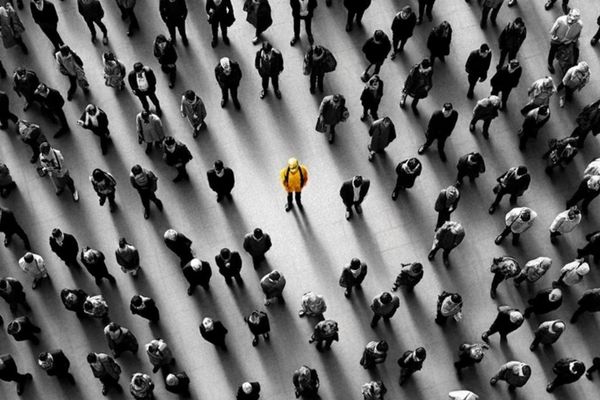
Belinda also received advice early in her career that appears to have saved her considerable energy: some people already understand the importance of the work, some are curious, and some simply aren't ready to listen.
The temptation, particularly when we care deeply, is to concentrate on the last group.
Why don't they understand?
How can we persuade them?
What argument will finally get through?
But there is a hidden cost.
Every hour spent trying to convert someone who is fundamentally uninterested is an hour not spent helping someone who is already ready to act.
Belinda eventually became more deliberate about putting her energy towards people who were open to the conversation. That mindset helped her keep going despite criticism and being labelled things such as the “fun police” for challenging accepted ideas about food and convenience.
It's a useful principle far beyond nutrition.
You don't have to convince the sceptic.
You don't have to win every argument.
You don't even have to be understood by everyone.
Sometimes your job is simply to make the useful thing available to the people who are ready for it.
The next level of influence isn't always more effort
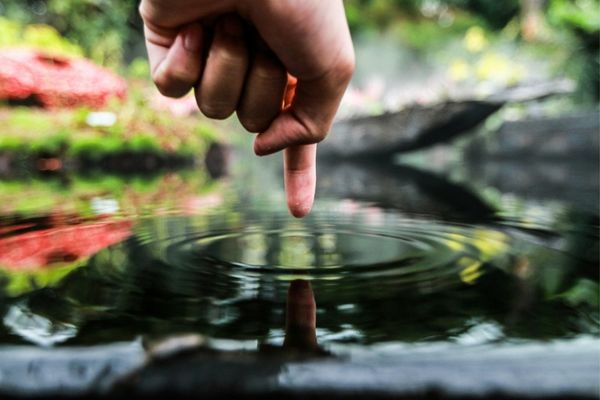
This is where Belinda's career has taken another interesting turn.
After years of grassroots work, she is shifting towards education leaders and decision-makers, developing a food literacy framework for schools. Her argument is that food shouldn't be treated as an optional extra when schools are already thinking about learning, behaviour and wellbeing.
That's not abandoning the people she cares about.
It's changing the level at which she works.
Instead of asking, “How can I personally reach more families?” the question becomes, “Where could my work influence the environment in which thousands of families are already making decisions?”
That is leverage.
And it is a particularly useful idea for the messy middle, because midlife can involve an uncomfortable collision between wanting to contribute and having less spare capacity to throw at everything.
You may still care just as much.
You may simply no longer have the energy to do it the way you did at 35.
That doesn't necessarily mean you've become less committed.
Perhaps you've become more strategic.
Your influence may already be closer than you think

Belinda's thinking about influence also comes back to something much smaller than schools or systems: home.
Many parents tell her they don't want to become the person constantly challenging schools, campaigning for change or telling everyone else how to live.
Her answer is reassuring.
You don't have to.
You can model what matters in your own home.
Belinda experienced this when her daughter wrote to her before travelling overseas. Among the things her daughter thanked her for was the food she had grown up with, including the hope that she would one day feed her own children in a similar way.
That doesn't mean Belinda controlled every choice her daughter made.
She didn't.
Her daughter ate plenty of less nourishing food while travelling too, and Belinda understood that this was part of allowing another adult to make her own choices.
The important thing was what had already been modelled.
That is a quieter form of influence.
It doesn't look like campaigning.
There may be no applause.
You may never know exactly when it lands.
But influence doesn't always announce itself when it happens.
What if your job isn't to carry the whole cause?

This is where the conversation becomes bigger than food.
We can spend enormous amounts of energy trying to fix things we care about: family dynamics, workplaces, communities, social issues, other people's habits, other people's opinions.
The instinct is understandable.
But it can also turn contribution into a full-time responsibility for outcomes we don't actually control.
Belinda's story suggests a different model:
Model what you believe.
Help the people who are ready.
Build environments that make better choices easier.
Find the decision-makers who can influence the system.
Let other people own their choices.
That is not giving up.
It is recognising the difference between influence and control.
And perhaps that distinction becomes more important as we move through midlife.
We may have spent years believing that being a good mother, colleague, partner, friend or community member means anticipating everything and fixing everything.
Eventually, something has to give.
It doesn't have to be your values.
It might be your belief that you personally have to carry them everywhere.
The question isn't “How do I change everyone?”
It's:
Where can my contribution actually travel?
Maybe that's your children.
Maybe it's one colleague who is curious.
Maybe it's a classroom.
Maybe it's a boardroom.
Maybe it's a community group.
Maybe it's writing something that reaches people you've never met.
Maybe it's changing the way you do your own work so that other people can copy the model.
The size of the audience isn't necessarily the measure of the impact.
Sometimes the most influential thing you can do is put an idea into the right place, at the right time, for someone who is ready to do something with it.
That is a very different definition of contribution.
And a much more sustainable one.
Try this
Think of one issue you've been trying to change.
Then separate three things:
What can I control?
What can I influence?
What am I simply trying to convince someone else to care about?
You may find that the third category is consuming far more energy than it deserves.
Podcast Invitation
In the full Vitalify Unplugged conversation, Belinda shares the experiences that shaped her approach to food literacy, advocacy and influence — from her daughter's school lunchbox to years of grassroots work and her current shift towards influencing education leaders and decision-makers.
