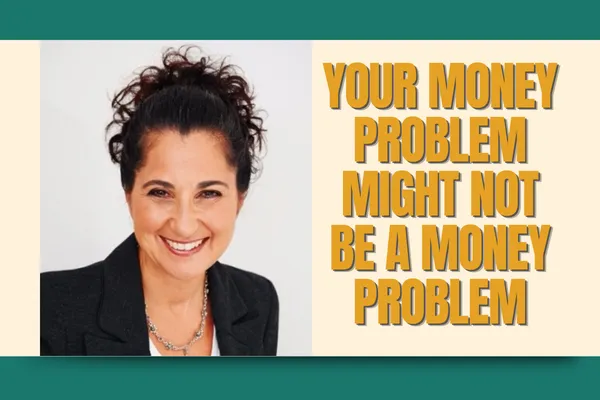
Your Money Problem Might Not Be a Money Problem
We tend to treat money anxiety as a numbers problem. Sometimes the harder question is what those numbers have come to mean about who we are.
There is a particular kind of financial frustration that has nothing to do with not knowing what to do.
You might understand budgeting. You might know you should be saving. You may even have grown up around people who were financially knowledgeable. And yet money can still make you feel anxious, guilty, avoidant or strangely incapable.
That contradiction is worth paying attention to.
Psychologist and wealth identity coach Linda Miller has spent years exploring the emotional stories people attach to money. Her own experience is part of what led her there. She grew up in a family of accountants, surrounded by financial knowledge, but discovered that knowing about money was not the same thing as feeling safe with it.
That distinction changes the question.
Instead of asking only, “What am I doing wrong with my money?”, we can start asking, “What have I learned to believe about money, and what does that belief say about me?”
When a cash-flow problem becomes a self-worth problem

Linda's most striking insight comes from a period when she believed her family simply had a cash-flow problem.
She was raising children, dealing with significant expenses and living with a persistent sense that there was never quite enough. Eventually, the pressure became so great that the family made the difficult decision to move their children out of private school because the fees were no longer sustainable.
Looking back, Linda came to understand the situation differently.
“What I thought was a cashflow problem was actually a self-worth problem.”
That distinction matters because money does not stay neatly inside the financial part of our lives. It can become tangled up with competence, status, belonging, responsibility and the fear of letting other people down.
The spreadsheet may tell you what is happening. It doesn't necessarily explain why your body reacts to it the way it does.
Linda describes financial anxiety as something that can involve the nervous system before it becomes a question of mindset. When financial pressure feels threatening, the experience can become much bigger than a calculation. We can become preoccupied with danger, loss and scarcity, making it harder to step back and consider what options we actually have.
That doesn't mean every financial problem is secretly psychological. Some problems really are financial problems. Bills need paying. Income matters. Debt matters.
But sometimes we are trying to solve the number while ignoring the story attached to it.
The money beliefs we inherit before we can question them

Most of us didn't sit down at eighteen and consciously decide what money meant to us.
We absorbed it.
We watched how adults talked about spending. We noticed whether money was discussed openly or behind closed doors. We learned whether asking for more was considered sensible, selfish or simply rude. We saw what happened when someone earned more than someone else. We noticed who was allowed to take financial risks and who was expected to be careful.
By adulthood, some of those messages can feel less like beliefs and more like personality.
“I’m just not good with money.”
“I've never been a risk-taker.”
“I don't need much.”
“I'd rather have security.”
“I don't want people to think I'm greedy.”
Those statements may contain genuine preferences. But they may also contain old rules we have never examined.
Linda puts it memorably:
“People spend according to their habits and they earn according to their fears.”
That line turns conventional financial advice on its head.
If fear influences how much we believe we are allowed to earn, then earning more isn't necessarily just a matter of ambition or strategy. If spending is connected to habit and emotional regulation, then a new budget may not be enough to change behaviour either.
This is particularly interesting for women, because money can carry an additional social charge. Linda points to the shame and discomfort that can surround talking about money, asking for more or appearing overly ambitious. Financial choices can become questions of belonging: Will people judge me? Will I become different from my friends? What will my partner think? Am I allowed to want this?
Once you see that layer, “I'm bad with money” becomes a much less useful diagnosis.
Perhaps the more useful question is: What am I afraid this money will say about me?
Wealth isn't necessarily about having more

Linda's definition of wealth is deliberately less numerical than we might expect.
For her, wealth means choice, freedom and joy.
That doesn't make money irrelevant. It makes money a tool rather than a verdict.
Gry's response to this idea adds another layer. She doesn't particularly want the traditional version of retirement for its own sake. What interests her is having the freedom to choose meaningful work.
That distinction is easy to miss.
Financial independence is often presented as the point at which you no longer have to work. But perhaps for some people, the more interesting goal is reaching a point where work becomes more genuinely chosen.
That might mean staying in a career because you enjoy it. It might mean changing direction. It might mean working less. It might mean taking a risk. It might simply mean having enough financial breathing room that every decision doesn't feel like a referendum on your survival.
The point isn't that everyone should want the same version of wealth.
It's that we should know what we're trying to create.
Before you fix the numbers, look at the meaning

There is a practical lesson here, although it isn't another budgeting hack.
The next time a financial decision produces a disproportionately strong emotional response, notice what happens before you immediately act.
Are you frightened?
Ashamed?
Trying to prove something?
Trying to avoid disappointing someone?
Assuming there isn't enough before you've looked at the actual numbers?
Or perhaps you're using “being sensible” to protect yourself from a possibility you secretly want to pursue.
None of those questions will pay a bill. But they may help you understand why a perfectly rational financial decision can feel surprisingly difficult.
And that matters because separating facts from the story around the facts creates room for a different kind of choice.
Linda's wider argument is not that we should stop caring about money. It is almost the opposite. We should care enough to understand the role it is actually playing in our lives.
Money can provide security. It can create options. It can support experiences, relationships and meaningful work. But it cannot reliably tell us whether we are successful, worthy or enough.
That is a job it was never designed to do.
The useful question may therefore be less “How much money should I have?” and more:
What kind of life am I hoping this money will make possible?
That question shifts the conversation from accumulation to agency.
And perhaps that is where a healthier money story begins.
Why listen to the episode?
In the full Vitalify Unplugged conversation, Linda Miller goes further into the relationship between money, identity, fear and choice, including the personal experience that changed the way she understood her own financial anxiety. She also explores why her definition of wealth has become less about accumulation and more about freedom, and why what counts as “enough” can change as we move through different seasons of life.
Podcast invitation
Listen to The Freedom to Design Your Life with Linda Miller for the fuller conversation about money, self-worth, choice and the stories we inherit about wealth.
