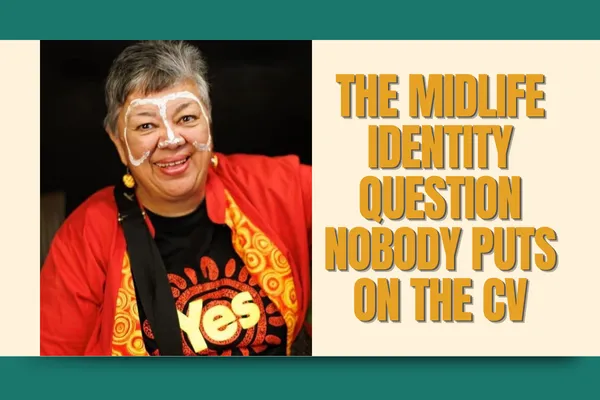
The Midlife Identity Question Nobody Puts on the CV
There is a particular kind of identity crisis that doesn't necessarily look like one.
Nothing dramatic has to happen. You can still have a job, a family, a house, a reasonably functioning calendar and a collection of achievements that looks perfectly respectable from the outside.
And yet, somewhere in the middle of life, the old answer to “Who are you?” can start feeling strangely inadequate.
For years, identity is often built around roles. Mother. Partner. Doctor. Teacher. Business owner. Manager. Carer. High achiever. The responsible one.
Then life changes.
Children grow up. Careers evolve. Health changes. Relationships shift. Parents age. You leave a role you thought you'd hold forever. Suddenly the labels that once explained you don't quite explain you anymore.
That is where Aunty B's perspective on identity becomes particularly interesting.
What if your identity isn't your résumé?
Aunty B, a Larrakia woman and senior cultural leader, doesn't describe identity primarily through qualifications, possessions or professional status.
She talks about Country, community and culture.
In the conversation, she puts it plainly: “My identity is about my country, my community and my culture.”
That statement is more radical than it may initially sound.
Many of us have been trained to construct identity through achievement. We accumulate qualifications, experiences and responsibilities, then use them to tell the story of ourselves.
This can work rather well while everything is moving in the direction we expect.
But it becomes more precarious when the roles change.
If your identity is heavily invested in being the person who earns the money, holds the family together, knows the answer, runs the business or takes care of everyone else, what happens when you can no longer — or no longer want to — play that role in quite the same way?
Aunty B's perspective suggests that identity can be held somewhere deeper than performance.
Belonging isn't the same as fitting in
There is an important distinction here.
Belonging isn't simply about being accepted by other people. It can also be about knowing where you stand in relation to the people, places, stories and responsibilities that have shaped you.
Aunty B describes storytelling as a way knowledge is carried between generations. Stories, song, dance, language, culture and connection are not simply entertainment or historical decoration. They help people understand where they come from and their relationship with the world around them.
That offers a useful challenge to the modern tendency to think of identity as an individual project.
We are often encouraged to “find ourselves” as though the self is a solo construction exercise.
Aunty B's worldview points in another direction.
Perhaps some parts of ourselves are discovered through relationship.
Who taught you how to cook? Who taught you what courage looked like? Which family stories explain where you came from? What places feel like home? Who are the people who know you without needing your job title explained?
Those questions aren't interchangeable with “What do you do?”
And for someone in the messy middle, that can matter.
The danger of becoming your own job description

Gry's reflection on the conversation is particularly relevant here: when roles, capacity or circumstances change, identity can shift too.
That isn't necessarily failure.
It may simply mean the version of you that worked in one season isn't sufficient for the next.
There is a temptation, particularly among capable women, to respond to this uncertainty by acquiring another identity. New qualification. New title. New project. New role.
Sometimes that's exactly what's needed.
But sometimes the deeper work is recognising that you don't have to replace one external definition of yourself with another.
Aunty B's own life contains a striking example of this.
She describes a period when she pushed herself through extensive commitments and eventually experienced a stroke. Afterwards, she stepped away from many committees and redirected her energy towards writing, language revitalisation, music, teaching and healing work.
The point isn't that everyone should respond to difficulty by abandoning their responsibilities. Nor should her personal medical experience be turned into a universal lesson.
What is interesting is the change in where she put her energy.
She didn't become less herself because some roles disappeared.
She made different choices about where that self would be expressed.
The people who know you beyond your achievements
There is something else worth noticing about the connection between identity and wealth.
If achievement is your primary source of self-worth, the loss of achievement can feel like a loss of self.
But if identity is also held in relationships, community and contribution, the picture becomes more resilient.
Your job can change without your entire identity disappearing.
Your children can grow up without your role as a parent becoming meaningless.
You can stop being the person who organises everything and still be someone people trust.
You can become less productive and remain deeply valuable.
That doesn't mean roles don't matter. They do. Work matters. Achievement can bring satisfaction, financial security and a sense of purpose.
The problem comes when we mistake a role for the whole person.
Perhaps this is why Aunty B's comments about wealth and identity belong in the same conversation. The things she considers valuable aren't isolated possessions. They are relationships, knowledge, Country, culture, family and contribution.
They are things that become part of you without needing to become your entire definition of you.
A different question for the messy middle
The useful question may not be:
“Who am I now?”
That can be a surprisingly intimidating question.
Try something more specific.
“What remains true about me even when my circumstances change?”
Perhaps you value curiosity.
Perhaps you're the person who makes people laugh when things become difficult.
Perhaps you are someone who notices when other people need help.
Perhaps your family stories matter enormously to you.
Perhaps you are a teacher even if you no longer work in education. A carer even when the person you cared for has died. A creator even when you haven't made anything for years. A daughter, sister, friend, neighbour or community member in ways that don't appear anywhere on your CV.
And perhaps there are parts of yourself you haven't had room to develop yet.
That is one of the more hopeful possibilities of the messy middle. You aren't necessarily losing an identity. You may be discovering that it was never as small as the roles you used to use to describe it.
Aunty B's perspective doesn't offer a tidy formula for identity. It offers something more interesting: a reminder that who we are can be held in connection, culture, relationships and the way we live, not simply in the things we achieve.
When the résumé gets thinner, the person doesn't necessarily become smaller.
Sometimes, you finally get to see more of them.
Podcast invitation
The full Vitalify Unplugged conversation with Bilawara Lee explores identity, wealth, culture, storytelling and legacy in much more depth. You’ll hear Aunty B explain how knowledge and identity are carried through story, song, dance and relationship — and why the way we conduct ourselves every day may be one of the most important things we pass on.
